Our Pomeranian Roots
Before the Duesterbeck family made a home in Wisconsin, their story began in Neu Damerow, in the historic Prussian province of Pomerania. To understand that journey, we need to look at the people, pressures, and events shaping this corner of Europe during the 1840s and 1850s.
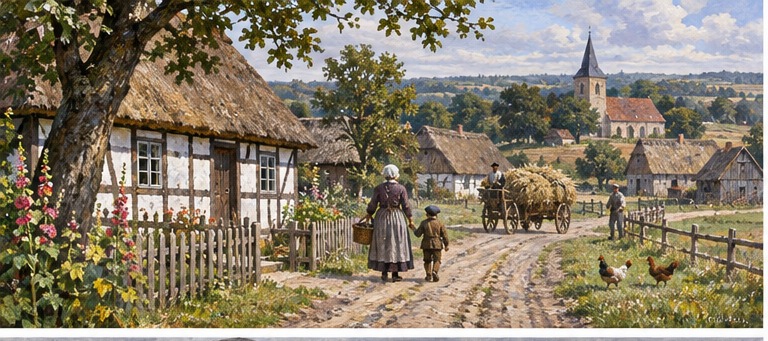
A Homeland of Villages and Farms
Pomerania—known in German as Pommern—was a historic region along the southern coast of the Baltic Sea. Much of its population lived in villages and depended on farming, estate work, and local trades. Our family research places the Duesterbeck line in Neu Damerow, Kreis Saatzig, in the eastern part of the historic province. The village is now known as Nowa Dąbrowa in Poland.
For rural families, land and livelihood were closely connected. A small holding or a laborer’s wages could be difficult to stretch across a growing household. Younger family members might find it hard to obtain land of their own or build an independent future. These pressures did not affect every household in the same way, but they formed part of the wider background to nineteenth-century emigration.
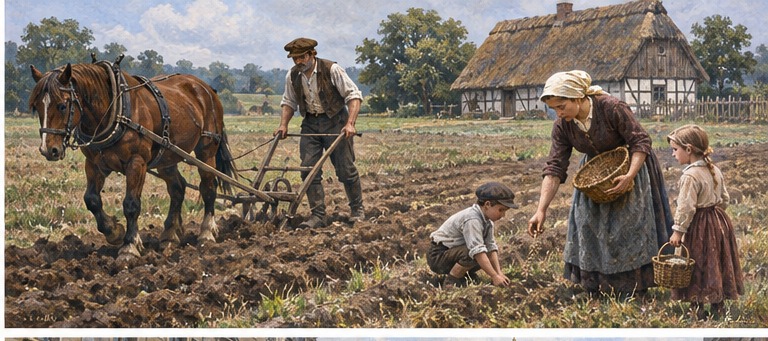
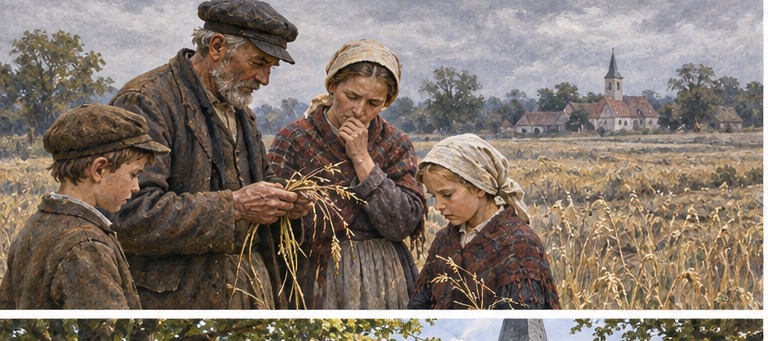
Hard Years: Harvests, Food Prices, and Opportunity
The middle of the 1840s brought serious hardship to parts of northeastern Germany. Poor harvests, including the grain failure of 1846, reduced already limited work opportunities while food prices rose. Research on rural Mecklenburg and neighboring areas describes the resulting strain on laboring families and the growing appeal of long-distance emigration. The potato blight devastated Ireland especially, but the wider European food crisis also affected German lands.
For a family considering its future, the prospect of owning land in America could be powerful. In the United States, settlers hoped to become independent farmers, provide for their children, and build lives that seemed increasingly difficult to achieve at home.
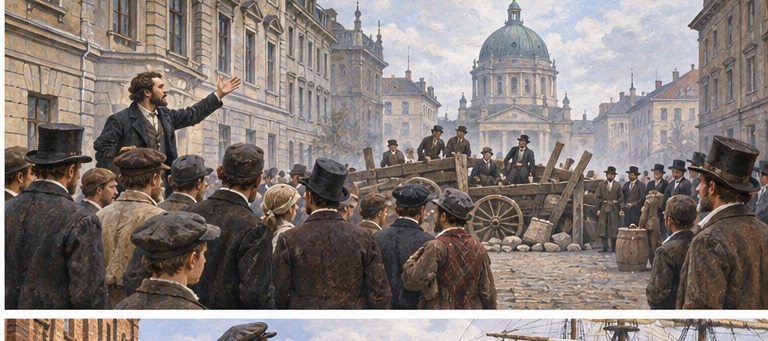
1848: Revolution and Uncertainty
In 1848, revolutionary movements swept through many European states. In the German lands, demonstrators called for constitutional government, civil liberties, freedom of the press, and national unity. Berlin, the capital of Prussia, saw demonstrations and street fighting. The revolutionary movement ultimately failed, and conservative authorities re-established control.
These events added to the uncertainty of the era and prompted some politically active people to leave. But it is important not to assume that every emigrant was a revolutionary or political refugee. For many rural families, economic opportunity and the hope of owning land were more immediate concerns.
Faith and the Old Lutheran Emigration
Religion was another important reason some Pomeranians left Prussia. In 1817, the Prussian crown promoted a union of Lutheran and Reformed Protestant churches. Lutherans who resisted the union—later known as Old Lutherans—sought to preserve their confessional practices and independent congregations. Some faced government restrictions and delays when seeking permission to emigrate.
Organized Old Lutheran groups left Pomerania and other Prussian provinces for North America during the late 1830s and 1840s. A study mapping more than 6,900 Old Lutheran emigrants found that Pomerania was a major source region. Yet the same research emphasizes that Old Lutherans made up fewer than one-fifth of Germans emigrating from Prussia between 1835 and 1854. Religious dissent was therefore a significant story, but it was not the explanation for most German emigration.
We do not yet have evidence that the Duesterbecks belonged to an Old Lutheran congregation or emigrated for this reason. Their church records and the original immigration evidence must be examined before making that connection.

Why America?
Across the 1840s and 1850s, America drew immigrants with the promise—though not the guarantee—of land, work, religious choice, and a new start. Letters from relatives and neighbors who had already settled in the United States helped spread news of opportunities and encouraged others to follow. Wisconsin and other Midwestern states became important destinations for German-speaking newcomers.
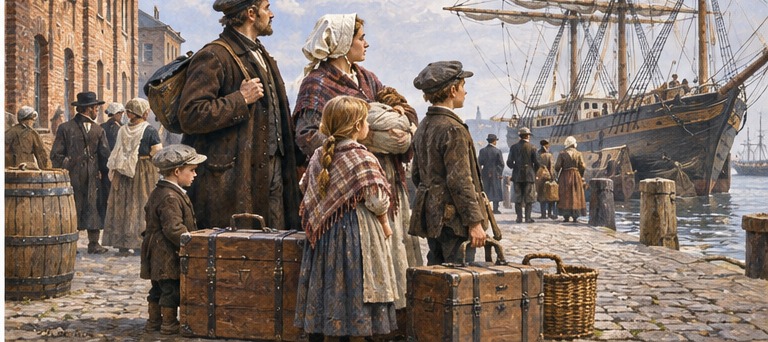
Migration was often a family decision made after weighing hardship at home against the risks of an ocean crossing and an uncertain future. The journey required money, planning, courage, and the willingness to leave familiar places, relatives, and traditions behind.
The Duesterbeck Journey: A Family Question to Explore
Our current family research associates an 1853 immigration reference with Samuel Friedrich Düsterbeck Jr. (born December 3, 1823, in Neu Damerow). A family reunion account published in the Lauderdale Lakes Breeze in 2024 reports that Samuel came from Pommern in 1853, settled in Theresa, Wisconsin, and later married Caroline Auguste Grassnickel. It also reports that his older brother Johann followed several years later.
The 1853 reference currently available to the family is a compiled passenger-and-immigration index citation, not yet a verified original passenger manifest. It is associated in the supplied family tree with Samuel Jr., although the same citation was also attached to his father’s profile. The precise record, identity, and arrival details still need to be confirmed. For that reason, we present 1853 as an important research lead rather than a fully proven arrival date.
What can be said with confidence is that the family’s reported migration belongs to a remarkable chapter in Pomeranian and German-American history. The same forces that shaped thousands of decisions across the region—economic pressures, changing political conditions, religious differences for some, and the attraction of opportunity in America—provide the historical setting for the Duesterbeck story.
Explore the Evidence and Continue the Story
Our next steps are to compare the Neu Damerow/Uchtenhagen church registers with the family tree, locate the original source behind the 1853 immigration index, and look for corroborating Wisconsin census, church, land, and naturalization records.
Return to Our Origins · Explore the Duesterbeck Family Tree · Visit Research & Resources
Sources and Further Reading
- Joel Seewald, “GIS Analysis of the Mid-Nineteenth Century Emigration of the Old Lutherans from Prussia” (2019) — maps the origins of 6,911 Old Lutheran emigrants and places their movement in the wider context of Prussian emigration.
- Trinity Freistadt Historical Society, “The Old Lutherans’ Attempts to Leave Prussia” — describes the religious conflict and the 1839 Pomeranian emigration.
- Archivaria, Old Lutheran Emigration List — Full Text Search — includes names and places in historical emigration lists, including entries from the Saatzig district.
- Research on rural migration and the 1846 agricultural crisis in northeastern Germany — discusses harvest failure, food prices, labor conditions, and emigration.
- Cambridge University Press, “East Prussia and the Revolution of 1848” — scholarly context for the revolutionary period in Prussia’s eastern provinces.
- UW–Madison Max Kade Institute, German-American Resources — includes a first-person Pomeranian emigration account describing how a letter from Wisconsin encouraged a family to seek land and independence.
- Lauderdale Lakes Breeze, Summer 2024, page 3, “Duesterbeck family reunion set for August” — the family-history account reporting Samuel’s 1853 emigration and settlement in Wisconsin.
Historical note: The six images on this page are newly created illustrations to help readers imagine the period. They are not archival photographs and do not depict identified Duesterbeck ancestors or specific documented events.

